In recent years, there has been a growing interest in indoor cultivation facilities for plant production, including greenhouses and vertical farms.
The main advantages of these facilities include the ability to protect plants from adverse weather conditions, enhance pest control, and enable control over resource utilization. To ensure year-round high-quality crop production, LED grow lights are necessary. This requires the correct selection of spectrum, intensity, and lighting duration.
Longer daylight benefits plant vegetative growth.
The duration of exposure to light, or more precisely the ratio of light to darkness within a 24-hour period, is referred to as the photoperiod. A common metric used to measure plant light exposure is the Daily Light Integral (DLI). DLI is the sum of all significant light intensities within a 24-hour period. Generally, the more photons a plant receives, indicated by a higher DLI, the better its growth and yield. However, each species has an optimal range of light intensity, and beyond that range, the efficiency of light absorption and photosynthesis decreases. Therefore, to achieve optimal vegetative growth, it is usually best to provide lower light intensity within a longer photoperiod. On the other hand, light-demanding crops can benefit from extended daylight even in regions with naturally high light intensities. For example, it has been reported that tomatoes have an optimal photoperiod of 14 to 18 hours, while sweet peppers prefer 22 hours.
During the night, plants consume the sugars they produced during the day.
During photosynthesis, plants convert absorbed photons, assimilated CO2, and water into sugars, which are accumulated. These sugars can later be used for building plant structures and biomass or to support growth, flowering, nutrient transport, synthesis of other biochemicals, and resistance to diseases. Plants, like animals, generate the required energy by "respiration" or burning using oxygen. Plant respiration occurs throughout the night. Under short photoperiods, when daylight is limited and nights are longer, plants tend to conserve sugars, for example, by limiting growth, to ensure enough energy for survival until morning (Gent 2018). Nighttime respiration is enhanced at higher temperatures and elevated CO2 concentrations. Many plants grow better and have higher yields under longer photoperiods with the same light intensity (i.e., the same DLI).
Do plants need darkness at night?
Plants have a different way of "resting" compared to animals. Many plants require a period of darkness for normal growth and development. They possess a biochemical mechanism called the "circadian clock" that initiates and synchronizes life processes such as growth, germination, and flowering. Regular dark periods can regulate the plant's internal biological clock. However, in certain cases, nighttime illumination may be beneficial for plant growth. For example, in some regions during winter, when daylight hours are shorter, artificial lighting can extend the photoperiod and promote growth. Additionally, certain crops, such as leafy greens, have a high demand for longer photoperiods, and nighttime lighting can fulfill their light requirements.
In summary, for most plants, longer daylight periods are beneficial for vegetative growth, while nights are utilized for respiration and other biological processes. However, specific photoperiod requirements and the applicability of nighttime lighting can vary depending on the plant species, growth stage, and specific environmental conditions. In indoor cultivation facilities, optimizing plant growth and improving yield and quality can be achieved by controlling the photoperiod and providing appropriate lighting conditions.
References
Demers, D. A., Gosselin, A. (2002).Growing greenhouse tomato and sweet pepper under supplemental lighting: optimal photoperiod, negative effects of of long photoperiod and their causes.
Acta Horticulturae,
580, 83–88.
https://doi.org/10.17660/ActaHortic.2002.580.9Gent, M. P. N. (2018). Dynamic carbohydrate supply and demand model of vegetative growth : response to temperature, light, carbon dioxide, and day length.
Agronomy,
8, 21.
https://doi.org/10.3390/agronomy8020021Paucek, I., Pennisi, G., Pistillo, A., & Appolloni, E. (2020). Supplementary LED Interlighting Improves Yield and Precocity of Greenhouse Tomatoes in the Mediterranean.
Agronomy,
10(July).
https://doi.org/10.3390/agronomy10071002Park, Y., & Runkle, E. S. (2017). Far-red radiation promotes growth of seedlings by increasing leaf expansion and whole-plant net assimilation.
Environmental and Experimental Botany,
136.
https://doi.org/10.1016/j.envexpbot.2016.12.013Park, Y., & Runkle, E. S. (2018). Spectral effects of light-emitting diodes on plant growth, visual color quality, and photosynthetic photon efficacy: White versus blue plus red radiation.
PLoS ONE,
13(8), 1–14.
https://doi.org/10.1371/journal.pone.0202386Runkle, E. S., & Heins, R. D. (2001). Specific functions of red, far red, and blue light in flowering and stem extension of long-day plants.
Journal of the American Society for Horticultural Science,
126(3), 275–282.
https://doi.org/10.21273/jashs.126.3.275Velez-Ramirez, A. I., van Ieperen, W., Vreugdenhil, D., van Poppel, P. M. J. A., Heuvelink, E., & Millenaar, F. F. (2014). A single locus confers tolerance to continuous light and allows substantial yield increase in tomato.
Nature Communications,
5(1), 4549.
https://doi.org/10.1038/ncomms5549Watson, A., Ghosh, S., Williams, M. J., Cuddy, W. S., Simmonds, J., Rey, M. D., Asyraf Md Hatta, M., Hinchliffe, A., Steed, A., Reynolds, D., Adamski, N. M., Breakspear, A., Korolev, A., Rayner, T., Dixon, L. E., Riaz, A., Martin, W., Ryan, M., Edwards, D., … Hickey, L. T. (2018). Speed breeding is a powerful tool to accelerate crop research and breeding.
Nature Plants,
4(1), 23–29.
https://doi.org/10.1038/s41477-017-0083-8Waycott, W. (1995). Photoperiodic response of genetically diverse lettuce accessions. Journal of the American Society for Horticultural Science, 120(3), 460–467.
https://doi.org/10.21273/jashs.120.3.460Zha, L., Liu, W., Zhang, Y., Zhou, C., & Shao, M. (2019). Morphological and Physiological Stress Responses of Lettuce to Different Intensities of Continuous Light . In Frontiers in Plant Science (Vol. 10, p. 1440). https://www.frontiersin.org/article/10.3389/fpls.2019.01440  EU PPWR Packaging Regulation Takes Effect Aug 12 | How Hortibest LED Grow Lights Fully Comply
 HPS to Tunable LED Grow Lights: Why Your Old Irrigation Schedule Will Cost You Yields
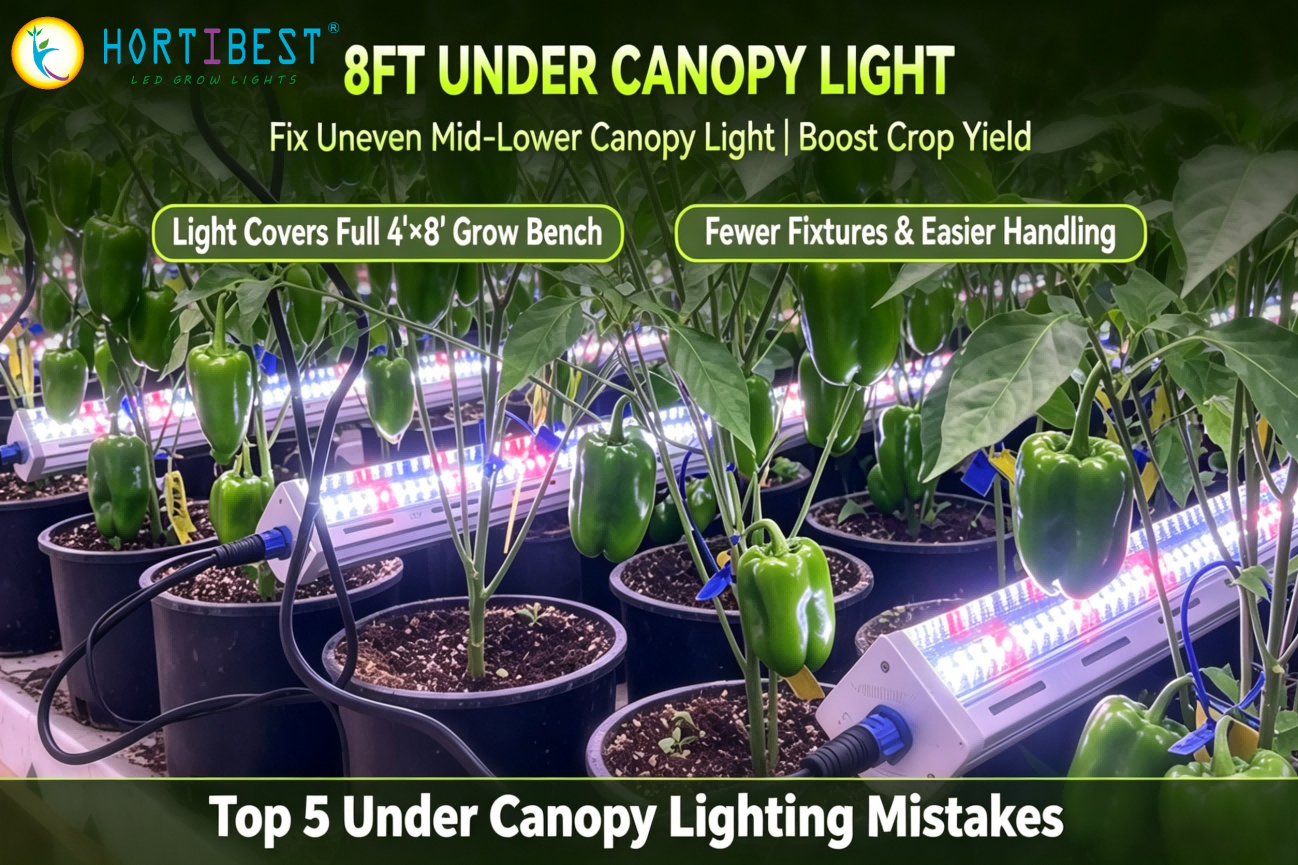 Top 5 Under Canopy Lighting Mistakes Commercial Growers Make | UCL Best Practices
 40% Higher Winter Strawberry Revenue: Minnesota Commercial Greenhouse Fixes High HVAC Costs & Pale Berries with Shark‑2600 Linear LED Grow Lights


