HPS to Tunable LED Grow Lights: Why Your Old Irrigation Schedule Will Cost You Yields

Views : 21
Author : Cherry
Update time : 2026-08-10 14:40:20
Many growers transitioning from HPS to tunable LED fixtures run into costly growing issues for one simple reason: they copy their proven HPS irrigation schedule directly onto LED systems, unaware of the core difference between fixed-spectrum HPS and modern multi-channel adjustable LEDs.

Let’s clear up a widespread oversimplification circulating in cultivation communities first: It is incorrect to claim all LEDs deliver identical canopy heating effects, while dimmable HPS cannot match LED’s spectral flexibility at all.

Modern HPS lamps paired with digital electronic ballasts only support overall power dimming to adjust brightness — their spectral composition stays permanently fixed. No matter how you turn down or ramp up the HPS power, it always outputs heavy yellow-orange light with massive built-in thermal infrared radiation. You cannot separately boost blue light for veg, or dial up far-red wavelengths to boost bloom potency; growers chasing tailored stage-specific light recipes have to install separate supplementary lights to cover missing bands.


By contrast, mainstream commercial LEDs like Hortibest OG8-3300 Tri-Channel foldable grow light deliver true independent spectral tuning, covering the full plant growth cycle from clones, vegetative growth all the way to late flowering. This fixture separates 3 fully adjustable channels: 450nm Blue, 660nm Deep Red, and White + 730nm Far-Red, letting growers dial custom light ratios for every crop stage without extra auxiliary lamps. Countless cannabis commercial cultivators intentionally crank up the far-red channel during flowering phases to boost resin, bud density and terpene production — a demand static HPS lamps simply cannot satisfy.

Even when you activate full far-red output on the Hortibest OG8-3300, its total radiant infrared heat never reaches the level of traditional HPS units. HPS’s inherent heavy thermal infrared blasts canopy leaves continuously, spiking leaf temperature far above ambient air and accelerating rapid evapotranspiration. Plants pull far more water and dissolved nutrients upward to compensate, forcing HPS operators to run frequent irrigation and fertigation cycles.

When switching to tunable LEDs like OG8-3300, your irrigation strategy must match your custom spectrum setting:
1. Low far-red spectrum for clone & veg stages: Transpiration slows dramatically. For most flowering crops, irrigation volume can safely drop 30%–50%.

2. Boosted far-red spectrum for bloom phase (the popular recipe for resin-heavy strains): Canopy heating and transpiration rise moderately, so you cut irrigation less drastically compared to low-far-red settings, but volumes still sit far below HPS irrigation benchmarks.

The 1 hidden trap almost every grower misses after switching
HPS constant infrared heat bakes the top layer of growing medium thoroughly, so surface dryness acts as a reliable visual watering cue.

LEDs lack that constant surface-baking radiant heat — this creates the dangerous false surface dryness trap. The top of your substrate may look pale and dry, while the deep root zone stays fully saturated. Judging watering timing by pot surface appearance is the top cause of root rot, oedema and mould outbreaks after switching light sources.

Discard visual surface checks entirely. Use substrate moisture probes to monitor moisture deep within the root zone, especially critical when running multi-spectrum tunable LEDs with variable far-red output.

A second costly universal mistake: Only tweak irrigation while keeping HPS-era ambient temperature setpoints unchanged. Leaf temperature controls photosynthesis and plant enzyme activity. Without HPS’s powerful radiant canopy heat, leaf temperatures will plummet and slow crop metabolism, even if air temperature stays identical.

Practical baseline climate shift for HPS-to-OG8 LED transition:
Typical HPS setup: 70–75°F ambient temperature
Starting setpoint for Hortibest OG8-3300 LED environments: 80°F – 85°F ambient temperature
Begin at 80°F and fine-tune based on your selected spectrum, strain and canopy density. Raising ambient air temperature compensates for lost radiant heat and stabilizes transpiration rates across all three growth stages.

Always calibrate VPD alongside temperature adjustments. Leaf temperature under tunable LEDs shifts your effective VPD completely; air sensor readings alone cannot reflect real plant growing conditions. Use an infrared thermometer to measure actual leaf surface temperature and tune your target VPD accordingly.

Higher ambient LED room temperatures help cut air conditioner runtime and slash monthly power bills — a standout advantage of high-efficiency LEDs like Hortibest OG8-3300, which hits 3.3μmol/J ultra-high efficacy to fully replace old 1000W HPS while lowering overall electricity expenditure.

One practical note: Warmer growing spaces often require enhanced dehumidification to stabilize humidity and avoid canopy moisture buildup, especially when running high-far-red bloom spectrums.

Step-by-step practical transition plan you can implement immediately with Hortibest tri-channel LEDs
Never slash irrigation volume by half overnight
Reduce water volume by roughly 10% every 3–5 days. Gradually establish your new baseline, and adjust based on your active far-red channel intensity.

Learn to read clear warning signs unique to LED grows
Overwatering signs under tunable LED: Slow substrate drying rate, persistent lower leaf yellowing, fungus gnats, stunted new bud growth
✅ Underwatering signs: Regular plant wilting mid light cycle, rapid moisture loss deep in the growing medium

Keep detailed logs during your first full LED growth cycle
Record substrate moisture, drain volume, plant health, and your three-channel spectrum ratios to refine irrigation routines for your specific strain.

Electrical efficiency and full-cycle spectral flexibility are the core strengths of tunable LEDs such as Hortibest OG8-3300. Even with these advantages, switching from HPS is never plug-and-play. Irrigation, climate settings and airflow must be adjusted in tandem. Proper airflow boosts canopy gas exchange and stabilizes leaf temperature to compensate for the lack of radiant heat generated by HPS, regardless of your chosen spectrum recipe.

Spectrum directly shapes plant development: Blue-heavy spectrums encourage compact, robust vegetative growth, while carefully tuned far-red improves flowering outcomes for high-resin crops, berries and premium cut roses. 

Transitioning from HPS/HID to tunable LEDs brings lasting improvements to crop quality, potency and energy efficiency. Success requires letting go of outdated HPS growing practices. Ignore generic universal irrigation advice. All environmental parameters should be adjusted according to your LED spectrum settings, cultivar, growing medium and indoor layout.
Related News
Read More >>
EU PPWR Packaging Regulation Takes Effect Aug 12 | How Hortibest LED Grow Lights Fully Comply EU PPWR Packaging Regulation Takes Effect Aug 12 | How Hortibest LED Grow Lights Fully Comply
Aug .11.2026
EU PPWR packaging regulation enters into force Aug 12 2026. Hortibest LED grow lights adopt recyclable kraft‑paper‑based packaging to help commercial & indoor growing clients avoid customs detention and fines. Get full PPWR compliance documents for your EU business.
Top 5 Under Canopy Lighting Mistakes Commercial Growers Make | UCL Best Practices Top 5 Under Canopy Lighting Mistakes Commercial Growers Make | UCL Best Practices
Aug .03.2026
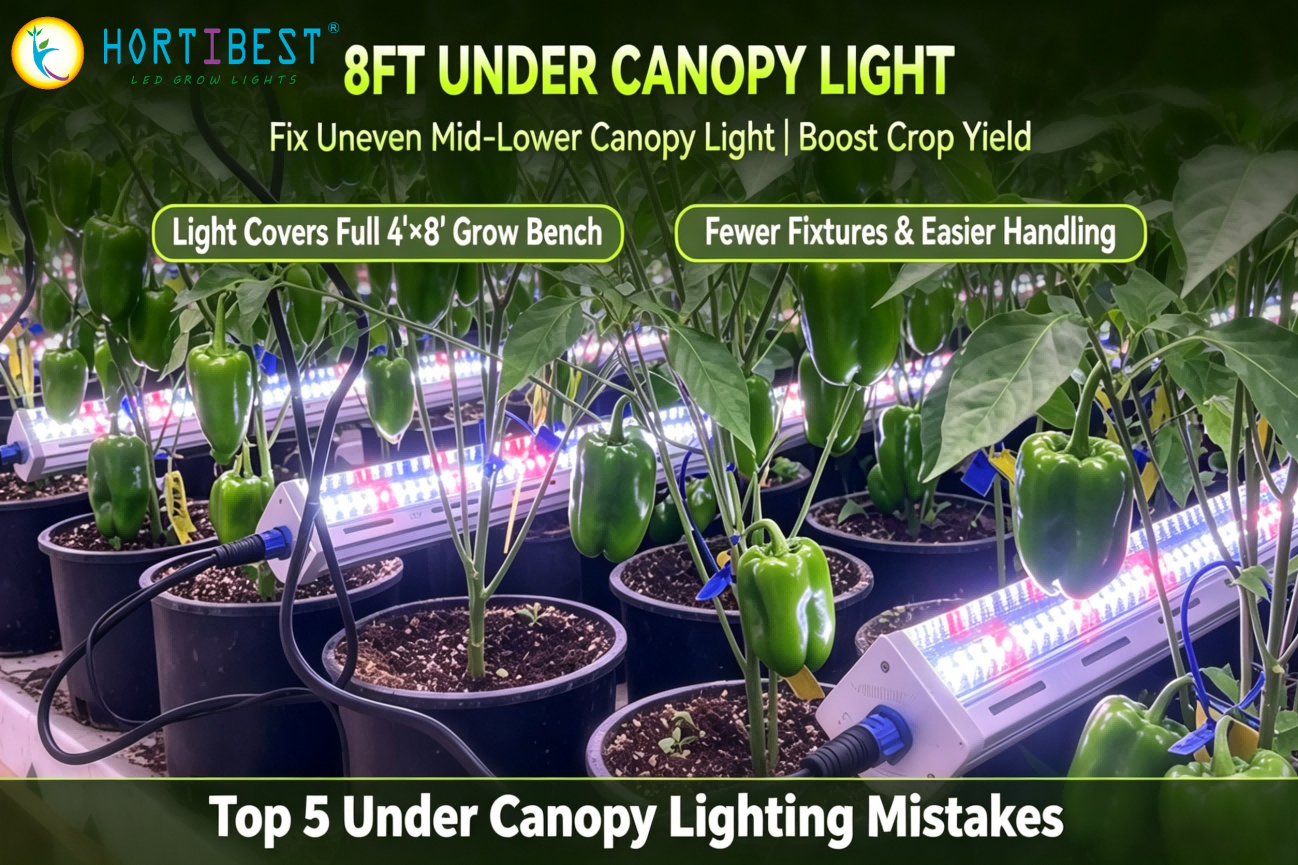
Many commercial indoor growers adopt Under Canopy Lighting to lift crop yields, yet costly errors wipe out lighting investment returns. Poor defoliation strategies, mismatched irrigation schedules, improper light acclimation, flawed trellis setups and overcrowded plant density are the top five under canopy lighting mistakes limiting harvest performance. Explore actionable grow room solutions to avoid light stress, uneven maturation and wasted UCL power, helping cultivators gain stable, higher profits from supplemental mid bottom lighting.
40% Higher Winter Strawberry Revenue: Minnesota Commercial Greenhouse Fixes High HVAC Costs & Pale Berries with Shark‑2600 Linear LED Grow Lights 40% Higher Winter Strawberry Revenue: Minnesota Commercial Greenhouse Fixes High HVAC Costs & Pale Berries with Shark‑2600 Linear LED Grow Lights
Jul .27.2026
Tired of low marketable berry yields, sky-high cooling bills and short high-price harvests in Minnesota cold greenhouses? Miller Berry Greenhouse upgraded outdated HPS to Shark‑2600 linear LEDs. Larger usable yields, 3 extra weeks of premium winter sales and fewer wasted cull berries combined to lift off-season revenue by 40%, while slashing lighting and HVAC energy costs.
Cloning Weed: What Is It & How to Clone A Weed Plant Cloning Weed: What Is It & How to Clone A Weed Plant
Jul .22.2026
Are you struggling with low cloning survival, stunted cuttings or fungal outbreaks? This practical propagation guide delivers actionable steps for every grower. Learn how to choose mother plants, control environment, tune light spectrum and PPFD, and harden new clones correctly. Scalable tri-channel LED lighting recommendations are included for small tent operations and large vertical farms. Apply these methods to achieve fast rooting and uniform, healthy clones.