What is LED Grow Lights Aging Test?

Views : 1207
Update time : 2023-06-21 11:28:46

Aging test refers to the test process of simulating various factors that affect the use of the product involved in the actual process and strengthening the corresponding conditions. The most common is the aging test for plastics, and the main methods are light aging, damp heat aging and hot air aging.

LED grow lights are electronic and electrical products. The aging test is different from the aging of plastic materials. The most important thing in the use of LED grow lights is to enable them to be used efficiently and normally, and the factors that affect their normal use are mainly dead light rate, heat dissipation, high efficiency, stability of light emission, etc. The main test methods are done by increasing voltage and current.

The dead light rate test of LED grow lights, generally speaking, after the LED grow lights are produced into finished products, there is no problem in the working room under the rated voltage and current. However, there will inevitably be a short period of high voltage or a sudden power-off on the lights during use. To ensure that the lights can still work normally after this common situation occurs, it is necessary to do a test before the LED grow lights leave the factory, so as to detect whether the power supply configuration is qualified, the welding position is firm, and the assembly wire has a certain bearing capacity.

The heat dissipation performance of LED grow lights is directly related to its service life and the luminous efficiency of lamp beads. The aging test method is to keep the LED plant lights at their maximum temperature within a certain period of time, and its internal structure will not be damaged. And within a certain period of time, the temperature of each component of the LED grow light will not increase with the high intensity working time increased.

LED grow lights have high efficiency and stability. Whether the LED plant grow lights are efficient and stable depends on the rectification and partial voltage capability of the internal power supply. As long as the quality of the power supply is excellent, LED grow lights can guarantee efficient and normal light within its rated service life under normal circumstances. In general, the power supply will be equipped with an overvoltage automatic power-off device, which will not have a serious impact on the lamp beads. However, it is not ruled out that the lamp wafer flaws will occur during the process of encapsulation. Therefore, a flash test is also required to ensure the lights are stable, normal and efficient work.

Generally speaking, the aging test is to test the lights' endurance of various situations that may be encountered in the actual application. The difference is the testing method and testing process.
Related News
Read More >>
EU PPWR Packaging Regulation Takes Effect Aug 12 | How Hortibest LED Grow Lights Fully Comply EU PPWR Packaging Regulation Takes Effect Aug 12 | How Hortibest LED Grow Lights Fully Comply
Aug .11.2026
EU PPWR packaging regulation enters into force Aug 12 2026. Hortibest LED grow lights adopt recyclable kraft‑paper‑based packaging to help commercial & indoor growing clients avoid customs detention and fines. Get full PPWR compliance documents for your EU business.
HPS to Tunable LED Grow Lights: Why Your Old Irrigation Schedule Will Cost You Yields HPS to Tunable LED Grow Lights: Why Your Old Irrigation Schedule Will Cost You Yields
Aug .10.2026
Many commercial growers run into costly cultivation mistakes when upgrading from HID to tunable LED lighting. Most continue using the same irrigation schedule proven for HID systems, ignoring critical differences in radiant heat, leaf temperature and transpiration. This guide explains how spectrum settings, especially far-red output, change plant water demand, and shares actionable irrigation adjustment strategies for lights like the Hortibest OG8-3300 tri-channel LED grow light.
Top 5 Under Canopy Lighting Mistakes Commercial Growers Make | UCL Best Practices Top 5 Under Canopy Lighting Mistakes Commercial Growers Make | UCL Best Practices
Aug .03.2026
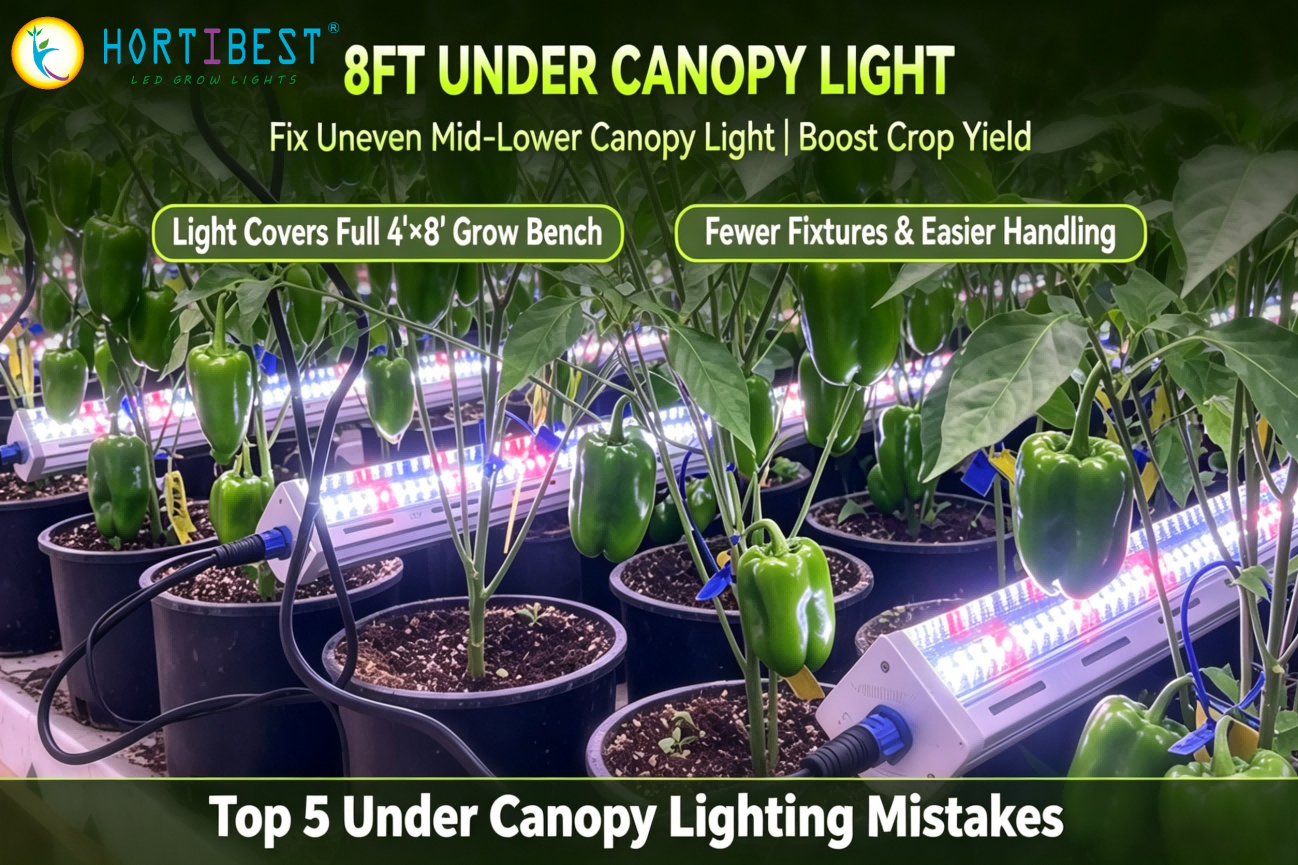
Many commercial indoor growers adopt Under Canopy Lighting to lift crop yields, yet costly errors wipe out lighting investment returns. Poor defoliation strategies, mismatched irrigation schedules, improper light acclimation, flawed trellis setups and overcrowded plant density are the top five under canopy lighting mistakes limiting harvest performance. Explore actionable grow room solutions to avoid light stress, uneven maturation and wasted UCL power, helping cultivators gain stable, higher profits from supplemental mid bottom lighting.
40% Higher Winter Strawberry Revenue: Minnesota Commercial Greenhouse Fixes High HVAC Costs & Pale Berries with Shark‑2600 Linear LED Grow Lights 40% Higher Winter Strawberry Revenue: Minnesota Commercial Greenhouse Fixes High HVAC Costs & Pale Berries with Shark‑2600 Linear LED Grow Lights
Jul .27.2026
Tired of low marketable berry yields, sky-high cooling bills and short high-price harvests in Minnesota cold greenhouses? Miller Berry Greenhouse upgraded outdated HPS to Shark‑2600 linear LEDs. Larger usable yields, 3 extra weeks of premium winter sales and fewer wasted cull berries combined to lift off-season revenue by 40%, while slashing lighting and HVAC energy costs.