LED grow light is an artificial light source that uses LED (light emitting diode) as the light source to meet the lighting conditions required for plant photosynthesis. LED grow light belongs to the third generation of plant grow light. In an environment that lacks of sunlight, LED grow light can act as sunlight, enabling plants to grow and develop normally and even better. This kind of grow light has the functions of strengthening plants' roots, promoting plant growth, regulating flowering period and flower color, promoting fruit ripening and coloring, and improving taste and quality!
Light environment is one of the important physical environmental factors that are indispensable for plant growth and development. Through light quality adjustment, controlling plant morphology is an important technology in the field of facility cultivation. Plant grow lights are more environmentally friendly and energy-saving. LED plant grow lights provide lighting for plant photosynthesis, promote plant growth, and shorten the time for plants to bloom and bear fruit, and increase production! In modernization, it is indispensable for crops. LED grow lights have the following main technical points:
Color temperature and lumens
The color temperature and lumens of plant lights are visible by human eyes, but the photosynthesis of plants to light does not depend on color temperature and lumens.
The effect of spectrum range on plant growth
280 ~ 315nm: minimal impact on morphology and physiological processes
315 ~ 400nm: less chlorophyll absorption, affecting the photoperiod effect and preventing stem elongation
400 ~ 520nm (blue): the absorption rate of chlorophyll and carotenoids is the largest, and has the greatest impact on photosynthesis
520 ~ 610nm (green): the absorption rate of the pigment is not high
610 ~ 720nm (red): the chlorophyll absorption rate is low, which has a significant impact on photosynthesis and photoperiod effect
720 ~ 1000nm: low absorption rate, stimulating cell elongation, affecting flowering and seed germination
>1000nm: converted into heat
PPF (Photosynthetic Photon Flux)
PPF (Photosynthetic Photon Flux) refers to the number of micromoles of photons radiated by artificial light sources per second in the wavelength range of 400-700nm, with the unit umol/s. The PPF value measures both the total luminaire value and the components at intervals of 100nm. This is because it is necessary to obtain the total PPF of the lamp, and to understand the components of different wavelengths, that is, the light formula; it can only be measured with an integrating sphere specially designed for testing plant grow lights.
PF value of far red (700-800nm)
PF value for far red (700-800nm) is listed separately. This is because far red is outside the range of photosynthetically active radiation and cannot be characterized by PPF. In particular, lamps with a far-red PF greater than 5% need to calculate the far-red PF maintenance rate for reporting.
PPE (Photosynthetic Photon Efficiency)
PPE (Photosynthetic Photon Efficiency) is greater than 1.9umol/J, and the lower limit is 1.6umol/J. Just like the light effect of lighting fixtures, plant lighting also sets the minimum light effect.
PPF maintenance rate
PPF maintenance rate Q90 is greater than 36000 hours. This is the life span standard of grow light fixtures;
For lamps using LEDs of multiple wavelengths, the LED manufacturer must provide LM80 data. LEDs with a PPF ratio greater than 25% in lamps, correspond to Q90>36000hr.
YPFD (Yield Photon Flux Density)
Corresponding to YPF is the number of micromoles of radiation per square meter per second, with the unit umol/m2s, which is the concept of density.
YPFD is the YPF expressed in the range of one square meter.
YPFD is a physical quantity related to the radiation distance, which is inversely proportional to the square of the irradiated distance.
YPFD can express more accurate the light quality of LED plant grow lights.
The relationship between PPFD and PPF: PPFD is the basic quantity obtained from the planting process parameters, and PPF is the main parameter of lamp manufacturing.
 EU PPWR Packaging Regulation Takes Effect Aug 12 | How Hortibest LED Grow Lights Fully Comply
 HPS to Tunable LED Grow Lights: Why Your Old Irrigation Schedule Will Cost You Yields
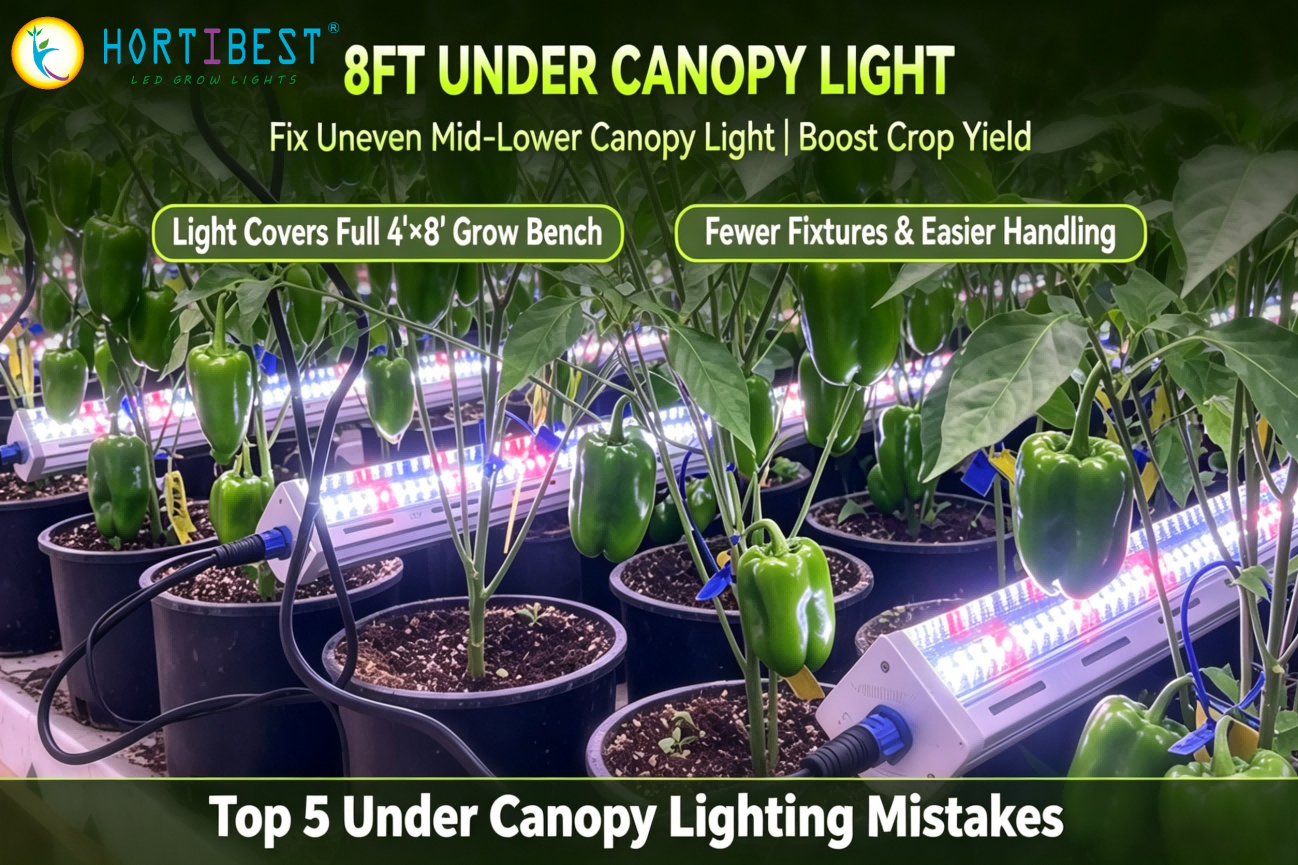 Top 5 Under Canopy Lighting Mistakes Commercial Growers Make | UCL Best Practices
 40% Higher Winter Strawberry Revenue: Minnesota Commercial Greenhouse Fixes High HVAC Costs & Pale Berries with Shark‑2600 Linear LED Grow Lights


