Hey ! If you’re scaling up your indoor farm or optimizing a greenhouse, you know lighting isn’t just about brightness—it’s about precision. Hortibest’s Octopus-G Series delivers exactly that, and today we’re breaking down two heavy hitters: the OG8-2700 and OG8-3300. Both are DLC-certified beasts for 4' x 4' canopies, but they serve different master plans. Let’s dig into which one deserves a spot above your crops.
The Core Difference: Dual-Channel vs. Tri-Channel Control
This isn’t just tech jargon—it’s crop strategy.
OG8-2700 (Dual-Channel):
Channel 1: Full-spectrum white + deep red (600–700nm)
Channel 2: Far-red (700–780nm) up to 60% PPF
Why it matters: Far-red drives photomorphogenesis—think stem elongation, flowering triggers, and shade avoidance responses. Perfect for crops like tomatoes, cucumbers, or ornamentals that need precise flowering control.
OG8-3300 (Tri-Channel):
Channels: Adjustable blue, red, and far-red independently.
Why it matters: Want seedlings under high-blue (450nm) for compact growth? Then switch to red/far-red for fruiting? This light’s tagline says it all: “Whatever spectrum you want. Just Do it!” Ideal for multi-stage facilities propagating lettuce, herbs, or berries.
Here’s what Our commercial users rave about:
1. Energy Efficiency & Longevity (DLC-Certified)
Both lights promise ≤10% decay over 5 years @ 12 hrs/day. Translation: No re-buying fixtures every 2 years. The OG8-2700 draws 850W, while the OG8-3300 uses 900W—but that extra 50W buys you 22% more PPF (3300 μmol/s vs. 2700 μmol/s). For high-light crops like peppers, that PPF boost means faster cycles.
2. Spectrum Flexibility = Crop Steering
OG8-2700 shines in flowering/fruiting stages: Its far-red dominance (60% PPF) accelerates phytochrome responses. Test data shows 5–10% faster flowering in photoperiod-sensitive crops versus standard LEDs.
OG8-3300 dominates vertical farms: Tri-channel tuning lets you mimic dawn/dusk spectra or adjust blue levels for compact basil. No more swapping lights between growth phases!
3. Installation & Scalability
Daisy-Chaining:
OG8-2700: 3 lights max @ 208–240V; 4 @ 277V
OG8-3300: 2 lights max @ 208V; 3 @ 230–277V
Pro Tip: The 2700 is friendlier for large warehouses on 208V grids.
4. Coverage & Uniformity (The Hidden Game-Changer)
OG8-2700 @ 1 ft: Delivers 1500 μmol/m²/s PPFD—ideal for low-canopy crops (microgreens, lettuce).
OG8-3300 @ 1 ft: Hits 1650 μmol/m²/s PPFD, punching through taller canopies (up to 5 ft).
Check the corolla schematics: The 3300 spreads light more evenly at tray edges, reducing “hotspot” yield gaps.
Real-World Scenarios: Which Light Wins?
Case 1: Leafy Greens & Herbs (Hydroponic Racks)
OG8-2700: Perfect for flat setups (NFT channels). Far-red minimizes “stretching” in low-light zones.
OG8-3300: Better for stacked systems. Dial up blue for tighter basil, then reduce to avoid over-hardening.
Case 2: Fruiting Crops (Tomatoes, Peppers)
OG8-2700: Far-red boosts fruit set and size. One Colorado grower saw 15% heavier peppers vs. static-spectrum LEDs.
OG8-3300: Use tri-channel to ramp red during fruiting. Bonus: Add blue at end to enhance anthocyanins in purple varieties.
Case 3: Propagation to Harvest (Multi-Zone Facilities)
OG8-3300 takes the crown. Start clones under high-blue (20%), transition to balanced veg spectrum, then blast red/far-red for flowering. One less fixture to buy!
The Nitty-Gritty: Specs That Impact Ops
| Feature |
OG8-2700 |
OG8-3300 |
| PPF (μmol/s) |
2700 |
3300 |
| Input Power |
850W ±10% |
900W ±10% |
| Dimming |
0–10V (Dual-Channel) |
0–10V (Tri-Channel) |
| Heat Output |
2006 BTU/h |
2388 BTU/h |
| Net Weight |
24.9 lbs (11.2 kg) |
25.5 lbs (11.6 kg) |
| IP Rating |
IP65 (Wet Rating) |
IP65 (Wet Rating) |
Note: Both run on 120–277V AC—crucial for older US greenhouses with 277V infrastructure.
Bottom Line: Match the Light to Your Crop Rhythm
-
Choose OG8-2700 if:
You grow flowering/fruiting crops or want extreme far-red control. It’s a lean, efficient workhorse.
-
Choose OG8-3300 if:
You run multi-stage ops, grow light-hungry crops (e.g., strawberries), or tweak spectra daily. The tri-channel pays back fast in crop flexibility.
Both lights are DLC-qualified, slashing your energy rebates by 20–40%—a big deal with rising U.S. electricity costs. And with IP65 ratings, they’ll survive greenhouse misting or vertical farm humidifiers.
Ready to optimize your canopy?
→ OG8-2700: For targeted photomorphogenesis & energy savings
→ OG8-3300: For spectral agility in dynamic grow rooms
Got specific crop questions? Our Hortibest techs live for this stuff. Ping us at Info@hortibest.com—we’ll help you max out those PAR maps!
Hortibest: Engineering Photosynthesis for the Next Harvest.
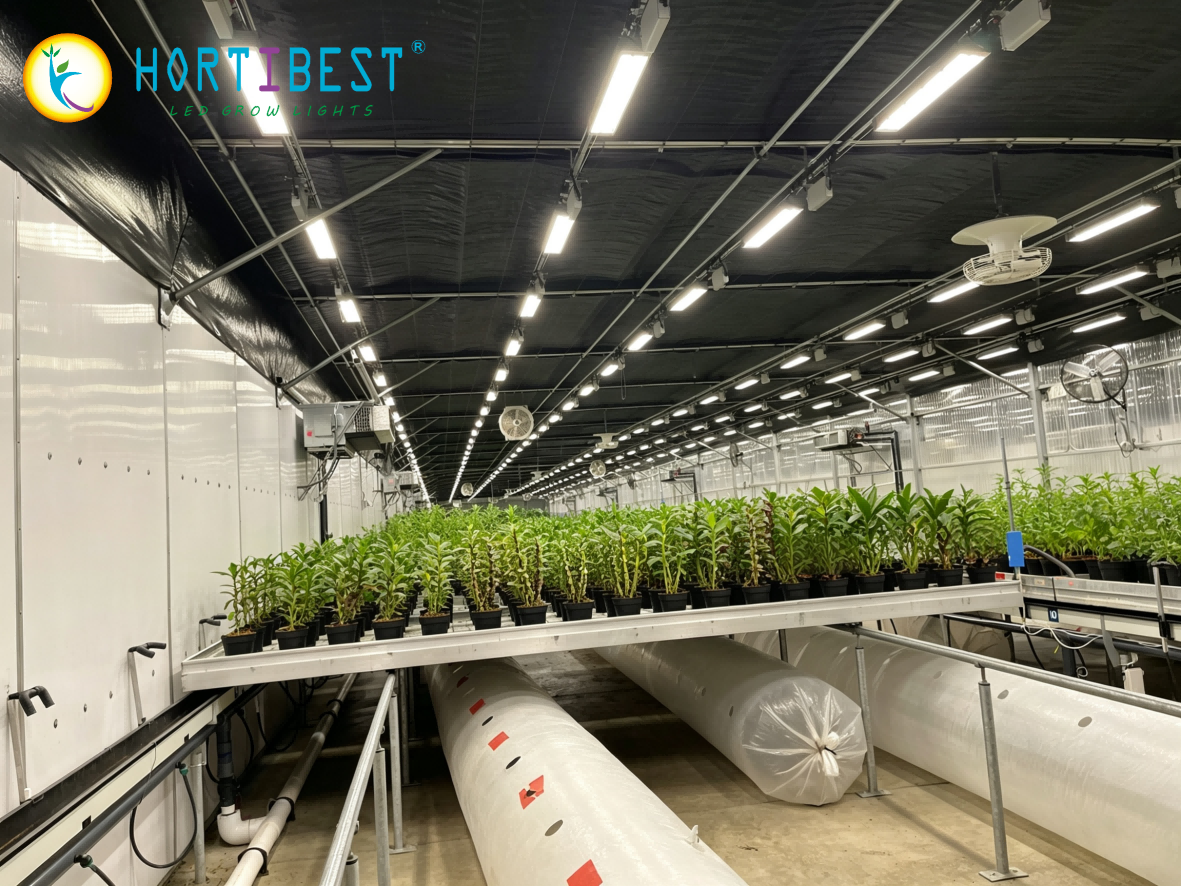 What Size Grow Light Do You REALLY Need? Stop Asking Watts – Use PPF, PPFD & DLI Instead
 HortiBest LED Grow Lights-Development History
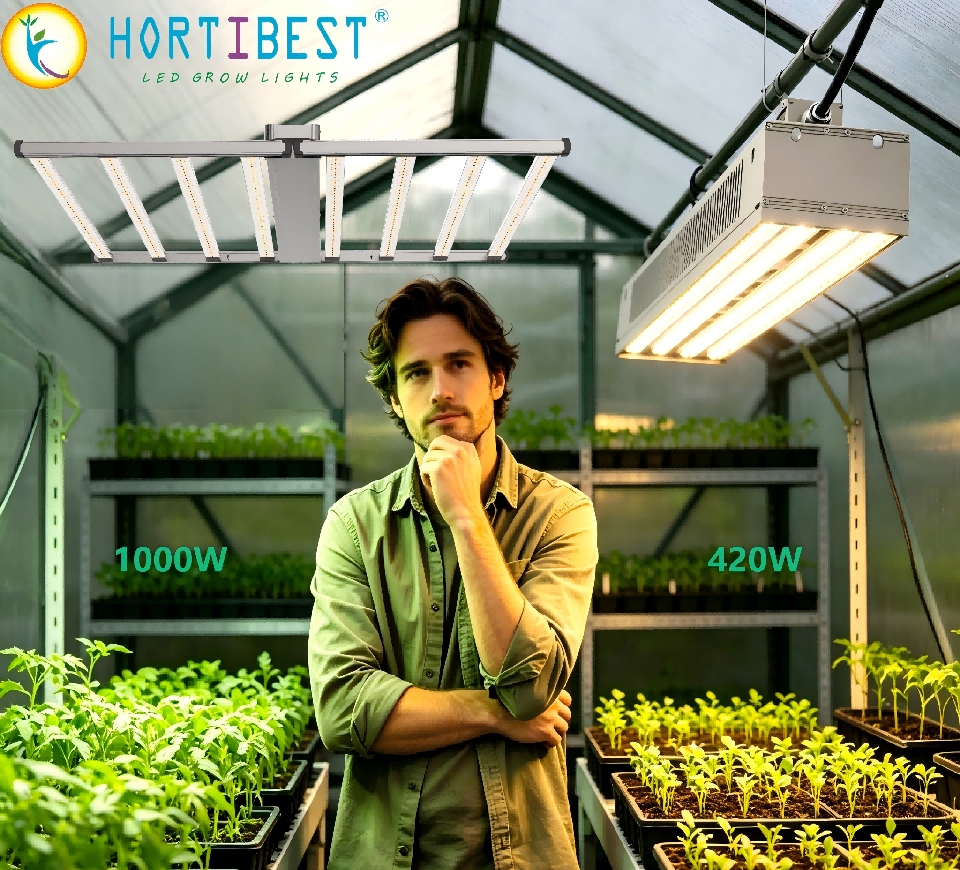 1000W vs 400W Grow Light: Which One Fits Your Grow?
 U.S. Federal Reclassification of Regulated Herbal Products: What It Means for Indoor Growers


