Over the past five years, Hortibest’s sales team and North American distributors have engaged with thousands of commercial growers who were previously staunch advocates of dual-ended HPS lamps. Most of them weren’t opposed to LED technology; they simply hadn’t found an alternative that was truly financially viable without sacrificing yield or compromising quality.
It wasn’t until they saw the Shark-2600’s actual test data and trial results that their questions began to change—from “Are LEDs really bright enough?” to “When is the earliest you can ship them to me?”
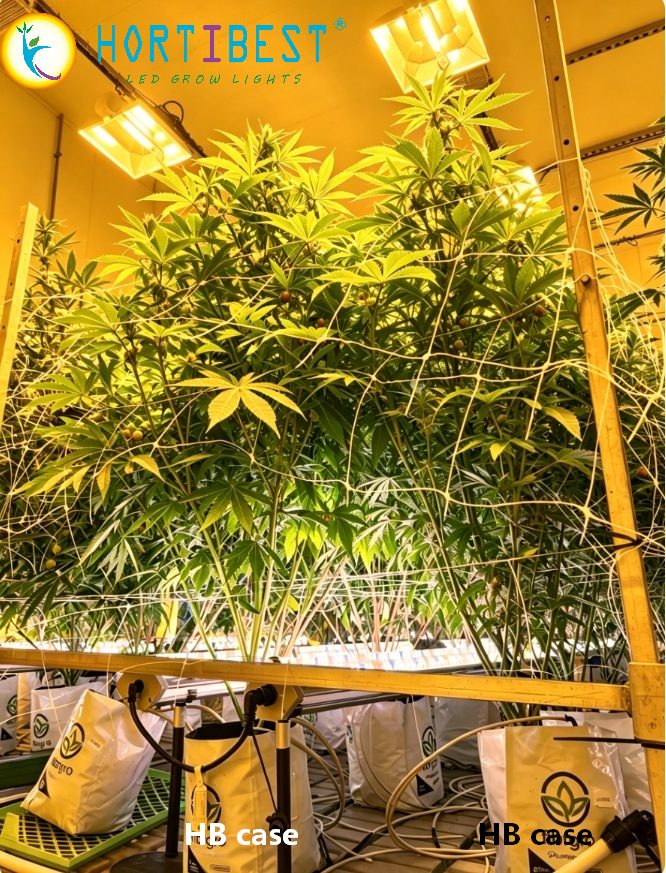
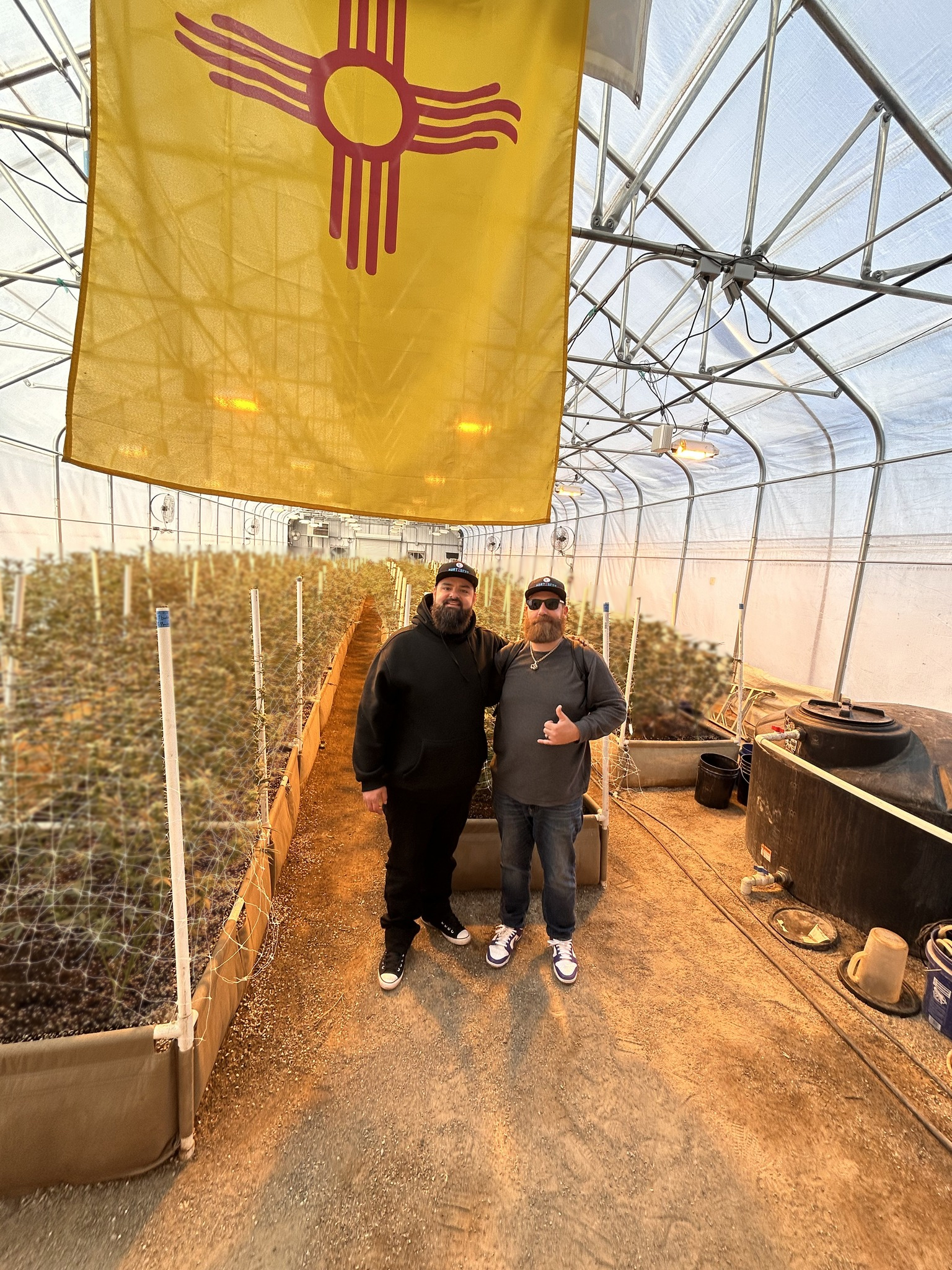
The following are classic questions that HPS growers repeatedly asked Hortibest sales representatives during the Shark-2600 trial phase.
Q1: “Are you a team that has actually grown cannabis, or are you just selling lights? In their view, it’s hard for anyone who hasn’t experienced mold, pests, and light damage firsthand to truly understand what they’re going through.”
A1:We don't just sell lights. We have our own cultivation lab where we run every fixture from seed to harvest — veg and flower. Our engineers log everything: reliability, heat, even pest pressure. We don’t guess. We test.
Internal test results: We removed the 1000W HPS and replaced it with the Shark-2600 as a top supplemental light. It save 24% on electricity, yield stays the same, THC levels hold steady, and lower‑canopy bud density and weight increase by 8–10% — all because the linear bar design reduces shadowing and delivers more uniform light to the middle and lower layers.
Q2: With such a large upfront investment, how long will it take to recoup the costs?
A2:We don’t give generic answers. We run an ROI calculation based on your actual electricity rate, canopy size, and local climate. But here’s a typical example for a medium-sized facility with 100 lights, 12-hour cycles, $0.12/kWh:
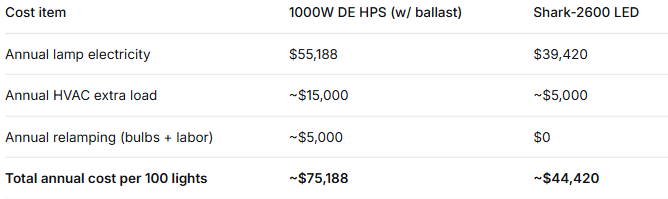
Annual savings: ~$30,768
Payback period: typically 6–12 months (faster in high-electricity markets like CA, NY, MA)
After payback, every dollar saved goes straight to your bottom line. And because Shark-2600 lasts ≥5 years without bulb changes, the cumulative savings over its lifetime often exceed $150,000 per 100 lights.
Q3: Compare your light spectrum curve to that of HPS—which one is stronger?
A3:“Stronger” depends on what you’re measuring. If you look at a spectrum graph, HPS has a massive spike in yellow/orange but almost no blue. Our Shark-2600 uses a full‑cycle blend: blue, white, red, and far‑red (FIF). Here’s the real-world comparison:
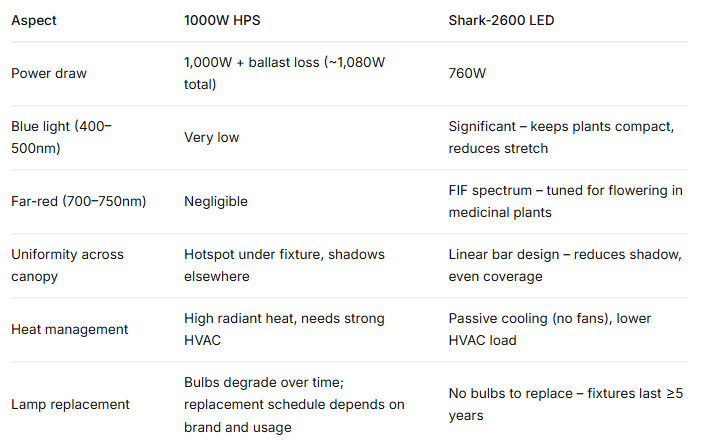
So is our spectrum “stronger”? It delivers more usable light per watt, better plant morphology, and higher lower‑canopy density – that’s stronger where it matters.
Q4: If the lights malfunction, will you just disappear?
A4: We’ve been in commercial horticulture lighting for over 20 years. We’re not a pop‑up brand. Here’s what we actually back up:
- US‑based warehouses – replacement parts and fixtures ship from stock, not from overseas.
- 5‑year warranty – if a light fails due to materials or workmanship, we replace it. No fine‑print runaround.
- Real support – you talk to people who have grown, not a ticket system in another time zone.
We designed the Shark‑2600 to minimize failures: passive cooling (no fans to die), IP65 sealing (survives humidity and washdowns), and aviation aluminum with hollow porous heat dissipation. But on the rare chance something goes wrong, we don’t disappear – we show up.
Q5: Is the light output sufficient? How much profit can I expect? How is the heat dissipation? Will it scorch my plants? And other similar questions.
A5: Yes, growers ask all of those – and the honest answer depends on your specific setup: canopy height, plant density, current HVAC, local electricity rate.So instead of generic numbers, we’ll run real numbers for you.
- Light output? We’ll send you our PPFD map for your layout.
- Profit? We’ll calculate your exact payback based on your electricity rate.
- Heat & scorch? We’ll give you the hanging height and airflow guidelines we use in our own grow lab.
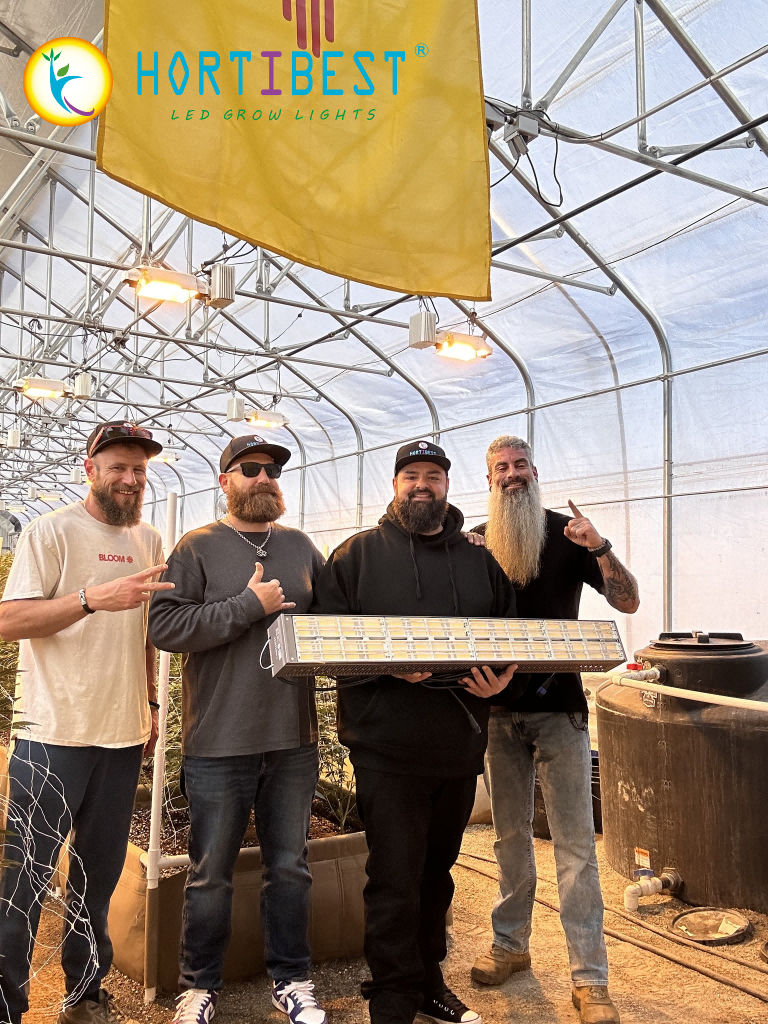
Want to know exactly what it can do for your grow?
Shoot us a message✉️ sales@hortibest.com or call for us 405-493-9315.
We’ll run a free ROI based on your numbers — or send you a unit to test yourself.
 EU PPWR Packaging Regulation Takes Effect Aug 12 | How Hortibest LED Grow Lights Fully Comply
 HPS to Tunable LED Grow Lights: Why Your Old Irrigation Schedule Will Cost You Yields
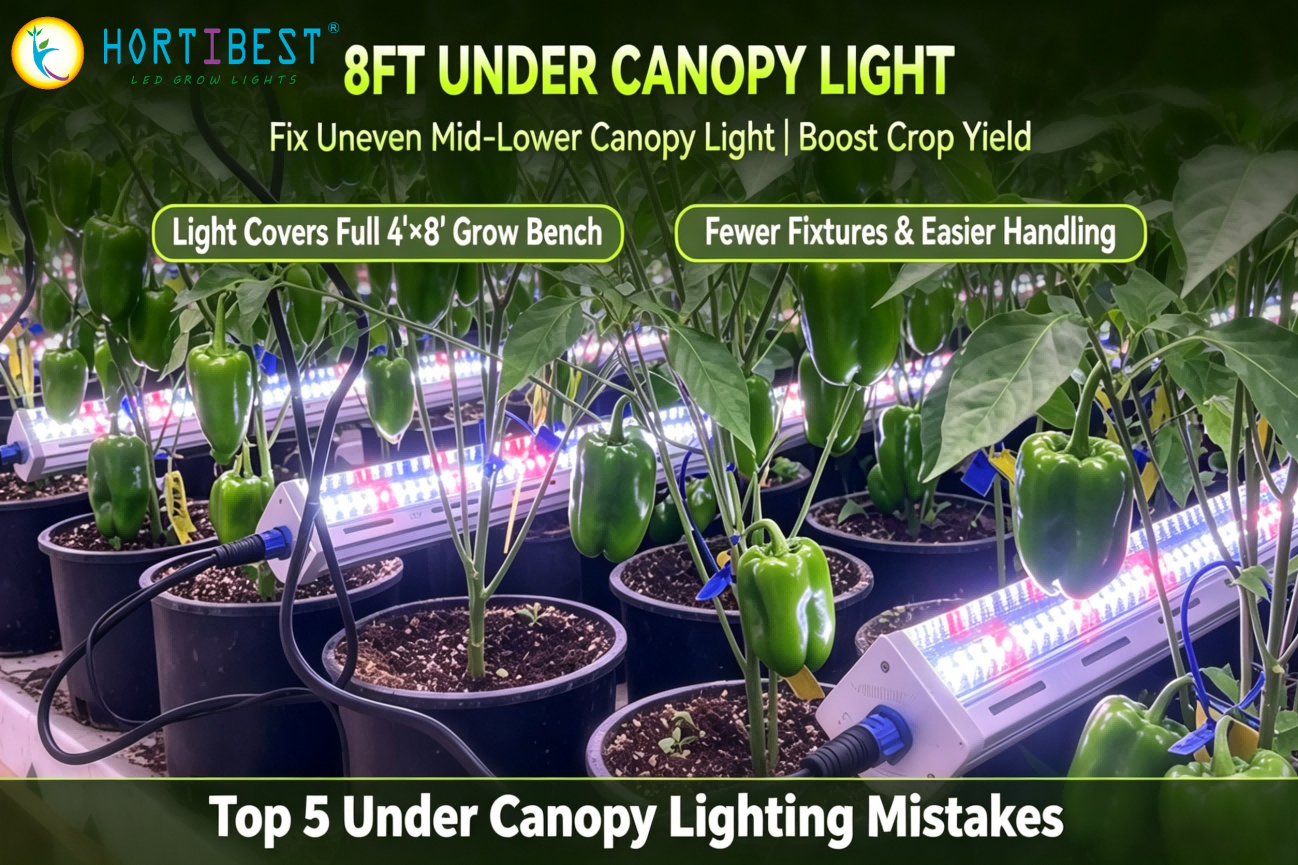 Top 5 Under Canopy Lighting Mistakes Commercial Growers Make | UCL Best Practices
 40% Higher Winter Strawberry Revenue: Minnesota Commercial Greenhouse Fixes High HVAC Costs & Pale Berries with Shark‑2600 Linear LED Grow Lights


