The light environment plays a crucial role in the growth and development of plants. Understanding how to optimize light quality and intensity can have a positive impact on plant morphogenesis. Additionally, LED plant lights, as an environmentally friendly and energy-saving innovation, not only promote plant growth but also shorten the flowering and fruiting time. This article will delve into the significance of the light environment for plant growth, and introduce the remarkable efficiency of LED plant lights.
The Importance of Light Environment for Plant Growth and Development:
Light serves as the foundation for plant growth and photosynthesis. The quality and intensity of light directly affect plant morphology, flowering, and fruiting. An appropriate light environment can enhance plant growth rate, increase leaf surface area, improve photosynthetic efficiency, and regulate plant morphology and physiological processes. The light environment also influences flowering time, yield, and quality. Therefore, optimizing the light environment is crucial for the healthy growth of plants.
Controlling Plant Morphogenesis through Light Quality Regulation:
Plants respond differently to various wavelengths of light. Harnessing this characteristic, plant morphology can be controlled by adjusting light quality. For instance, red light promotes vertical growth and flowering, while blue light stimulates lateral branching and leaf growth. Fine-tuning the ratio of red and blue light can achieve the desired plant morphology, such as compact plant structure and increased flower bud production. Moreover, different stages of plant growth require specific light cycles and intensities. Thus, by manipulating the light cycle and intensity, plant growth and development can be precisely controlled.
The Environmental and Energy-saving Benefits of LED Plant Lights:
Traditional plant lights, such as fluorescent or high-pressure sodium lamps, consume significant amounts of electricity and generate high levels of heat, lacking energy efficiency. However, LED plant lights, as a novel light source technology, excel in the field of plant cultivation. LED plant lights possess high energy conversion efficiency, stable light emission, and long lifespan. Compared to traditional light sources, LED plant lights consume only a fraction of the energy. This means that LED plant lights not only provide the required light for plants but also significantly reduce energy consumption and carbon emissions.
How LED Plant Lights Promote Plant Growth and Accelerate Flowering:
LED plant lights can provide red, blue, and other wavelength ranges of light to meet the needs of different growth stages in plants. By adjusting the light quality and photoperiod of LED plant lights, the growth process of plants can be accelerated, resulting in healthier and more vigorous plants. Furthermore, LED plant lights can shorten the flowering and fruiting time, thus enhancing yield and quality. The light quality regulation feature of LED plant lights enables them to simulate natural light conditions and provide the optimal spectrum required for plants, unlocking the growth potential of plants.
The light environment plays a crucial role in plant growth and development. By optimizing light quality and intensity, plant morphology can be precisely controlled. LED plant lights, as an environmentally friendly and energy-saving innovation, promote plant growth and accelerate flowering. Their high energy conversion efficiency and stable light emission make them an ideal choice for plant lighting. In the future, LED plant lights will continue to evolve and play a significant role in agriculture, horticulture, and other fields, supporting sustainable plant production.
 EU PPWR Packaging Regulation Takes Effect Aug 12 | How Hortibest LED Grow Lights Fully Comply
 HPS to Tunable LED Grow Lights: Why Your Old Irrigation Schedule Will Cost You Yields
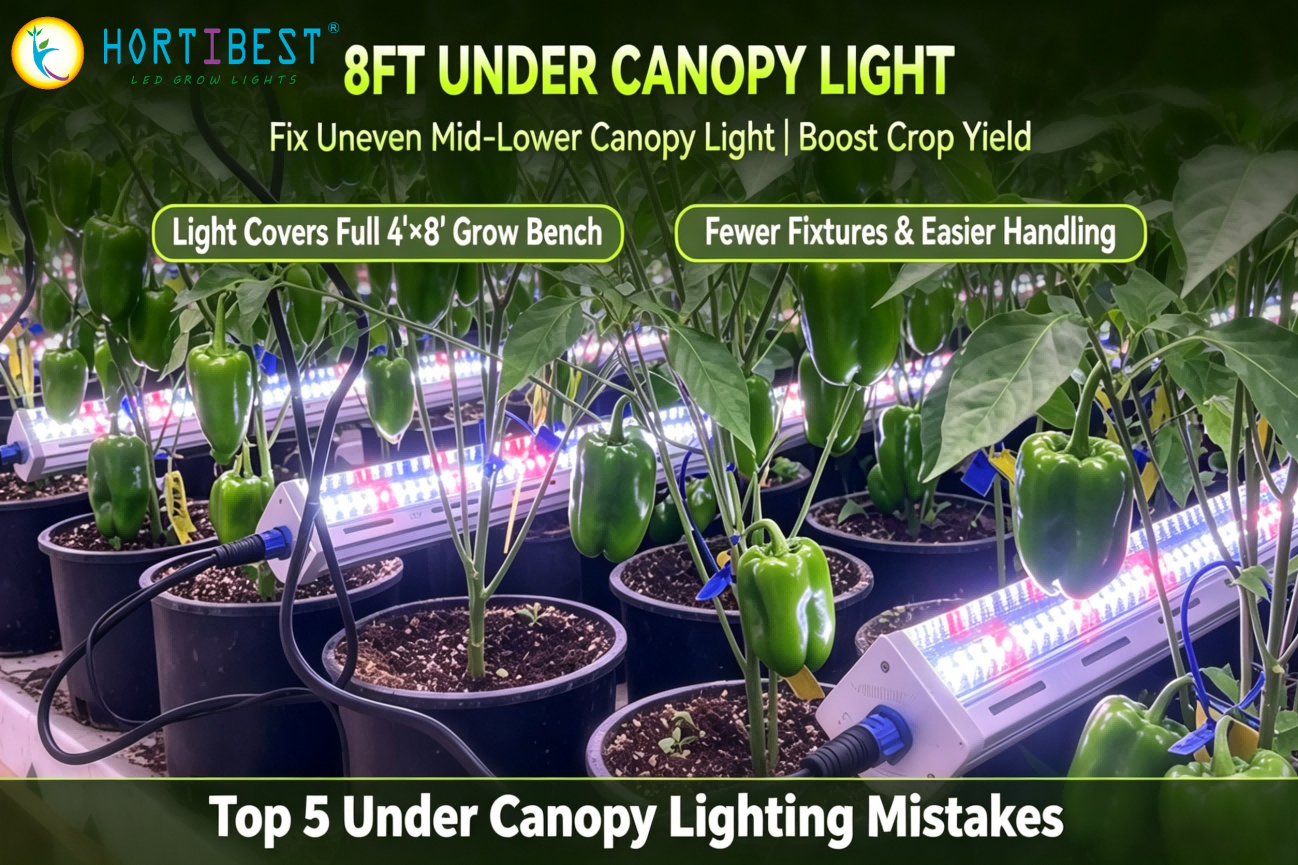 Top 5 Under Canopy Lighting Mistakes Commercial Growers Make | UCL Best Practices
 40% Higher Winter Strawberry Revenue: Minnesota Commercial Greenhouse Fixes High HVAC Costs & Pale Berries with Shark‑2600 Linear LED Grow Lights


